The Strasbourg Christmas market 2026 runs from Friday 27 November to Thursday 24 December. The chalets open every day from 11.30am to 9pm, with four late nights until 10pm (11, 12, 18 and 19 December), a 2pm start on opening day and a 6pm close on Christmas Eve. Entry is free, the eight markets sit in the historic centre ten minutes’ walk from the station, and no chalets open on 25 December.
Checked on 16 November 2026 against the official Strasbourg Capitale de Noël website (dates, hours, markets, parking, Grand Sapin), the European Parliament’s 2026 calendar, Eurostar, SNCF Connect and airline announcements for winter 2026-2027.
Some context on scale: the city counted 3.05 million visitors in 2025, after a record 3.4 million in 2024, in a city of about 294,000 people. Half of those visitors live in the Strasbourg metropolitan area. Locals go too; they just pick their days. This guide covers those days, the markets square by square, the journey from the UK and the US, and the checks on the bridges.
Dates and opening hours 2026
The official hours are the same on weekdays and at weekends, apart from the exceptions below.
| Day | Chalet opening hours |
|---|---|
| Friday 27 November 2026 (opening day) | 2pm-9pm |
| Saturday 28 November to Wednesday 23 December | 11.30am-9pm, every day (except the late nights below) |
| Friday 11 and Saturday 12 December | 11.30am-10pm |
| Friday 18 and Saturday 19 December | 11.30am-10pm |
| Thursday 24 December (last day) | 11.30am-6pm |
| 25 December to New Year | No chalets open |
After Christmas Eve the squares are empty, but the lights stay on. The Grand Sapin, the big Christmas tree on Place Kléber, is lit from 27 November 2026 to 3 January 2027: 4pm-9pm with music, then 10pm-midnight without. The tourist office at 17 Place de la Cathédrale opens daily from 9am to 7pm in December, closing at 5pm on 24 and 31 December, and from 10am to 5pm on 25 December.
The eight markets, square by square
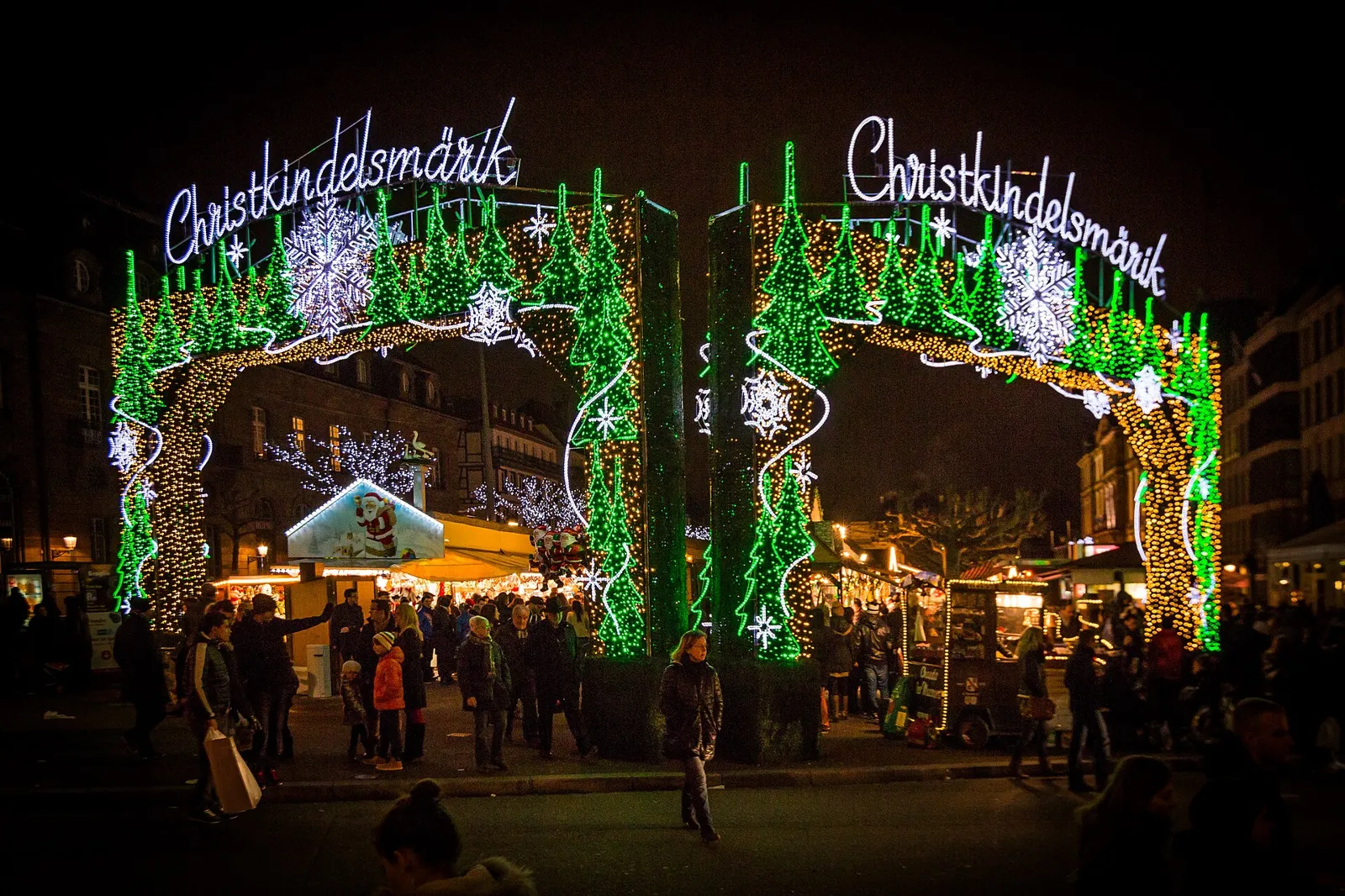
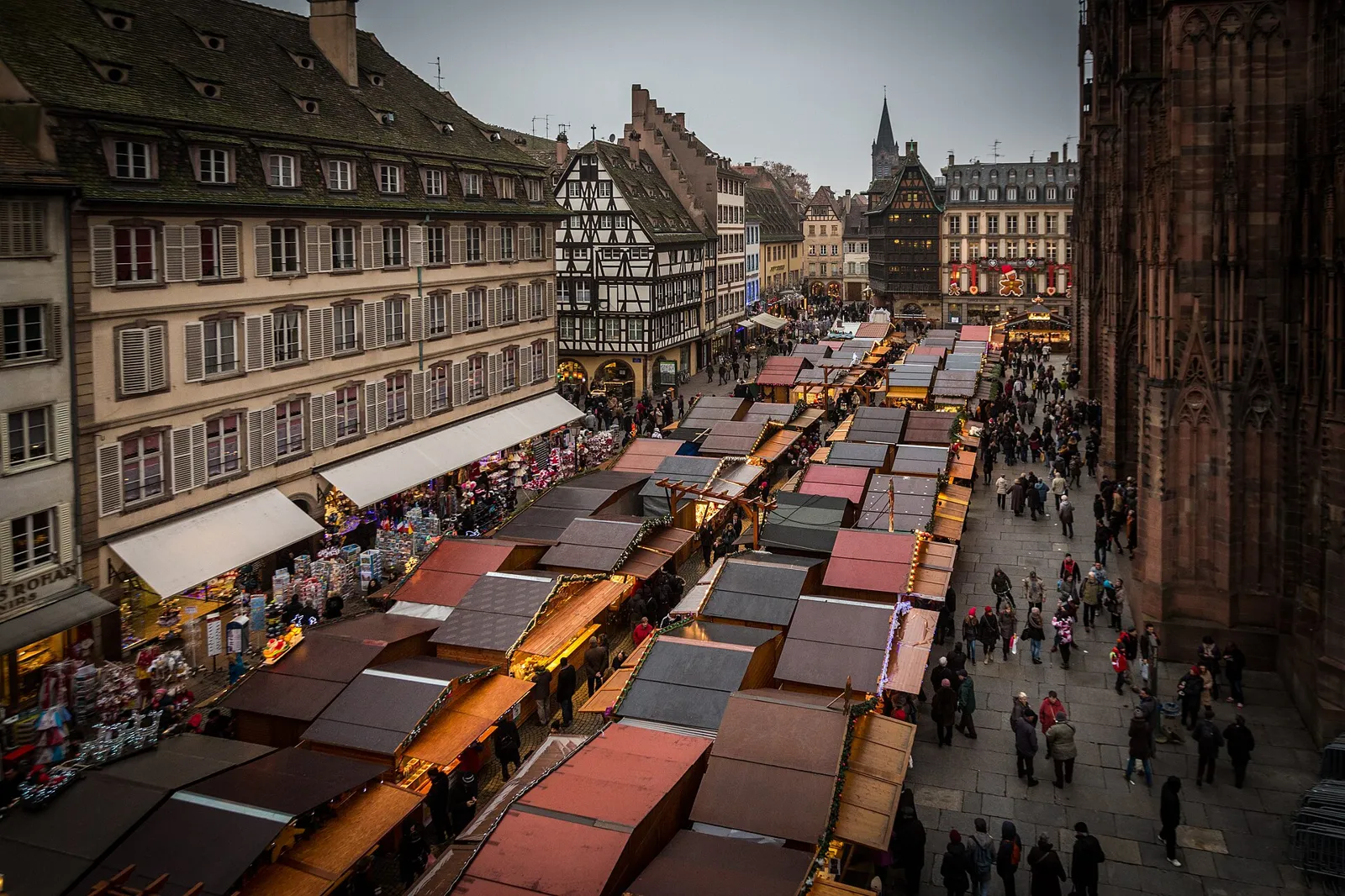
“Strasbourg, Capitale de Noël” is the name of the whole event. The Christkindelsmärik, Alsatian for “market of the Christ Child”, is only its oldest part. All eight sites are on the Grande Île, the historic centre ringed by the River Ill, and you can walk between them in a few minutes.
| Market | Location | What you will find |
|---|---|---|
| Christkindelsmärik | Place Broglie | The historic market, founded in 1570, with its illuminated arch |
| Autour de la Cathédrale | Place de la Cathédrale and Place du Château | The traditional market at the foot of the cathedral |
| Au pied du Grand Sapin | Place Kléber | The Village du Partage (charity village, 110 associations) and the chefs’ soup |
| La Petite France | Place Benjamin-Zix and Place Saint-Thomas | Craft chalets among the half-timbered houses |
| Les Irréductibles Petits Producteurs d’Alsace | Square Louise-Weiss | Food made in Alsace: jams, chocolate, biodynamic wines |
| Le Quai des saveurs et des savoir-faire | Terrasse Rohan and Place du Marché-aux-Poissons | The food market: winemakers and bakers |
| Marché du Carré d’Or | Place du Temple-Neuf | Crafts, in the street of pastry shops and chocolatiers |
| Marché OFF | Place Grimmeissen | Social and solidarity economy, in shipping containers |
A half-day walk from the station
From the station, head first to Petite France (Place Benjamin-Zix and Place Saint-Thomas), then Square Louise-Weiss for the Alsatian producers. Walk up to Place Kléber and the tree, then Place Broglie. Finish with the Carré d’Or, the cathedral and the food market by the river. After dark, look at the quays: the “promenade aux étoiles” strings almost 400 illuminated stars between the Pont du Corbeau and the Pont Saint-Guillaume.
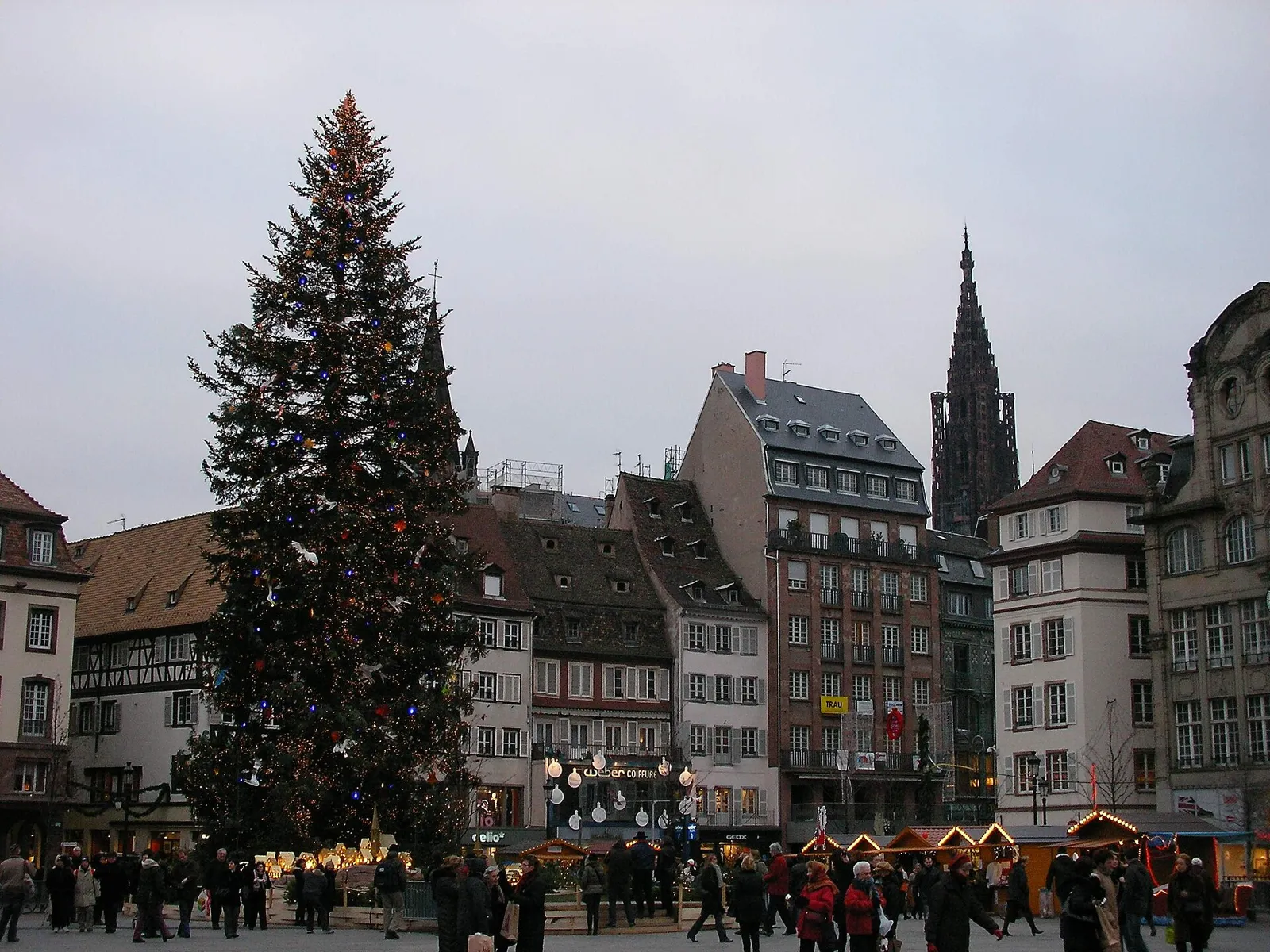
The Grand Sapin on Place Kléber
The 2026 tree comes from the Walscheid state forest, in the Vosges. According to the city, it is 30 metres tall and weighs 11 tonnes. At its foot, the Village du Partage serves the “soupe étoilée”, a soup cooked by Michelin-starred chefs from the region for the Humanis network of charities.
What to eat and drink
Mulled wine (vin chaud) is usually red, but Alsace also makes it with white wine: at the riverside food market, the Tribu des Gourmets winemakers serve a white version. For a soft option, hot apple juice is the drink of the producers on Square Louise-Weiss. For something sweet, look for bredele, the small Alsatian Christmas biscuits flavoured with aniseed, cinnamon or almonds. The Bas-Rhin bakers’ federation bakes them on site in a pop-up bakery.
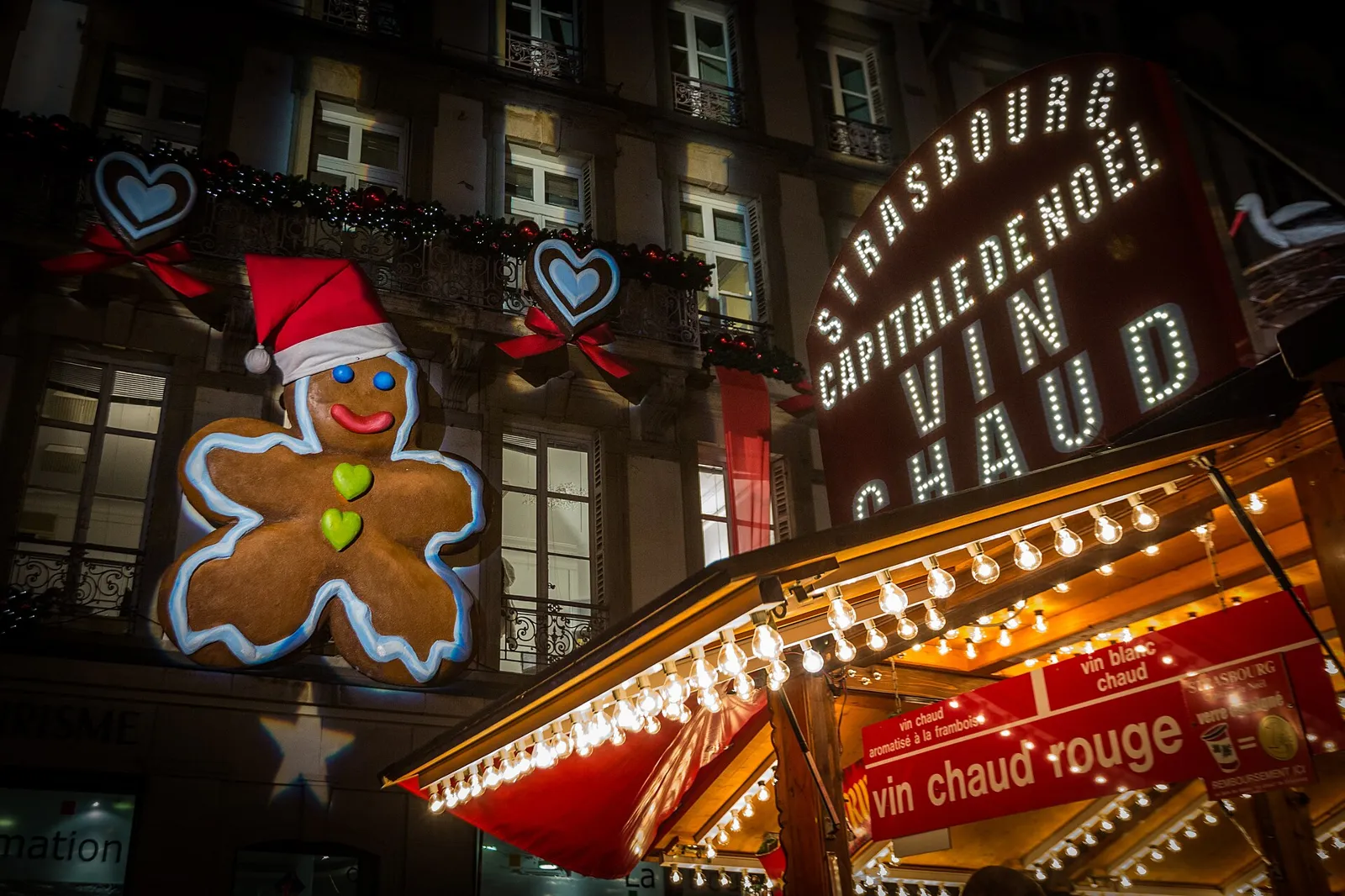
Every drink comes in a reusable cup with a €1 deposit. You can return it to any chalet selling drinks, not just the one where you bought it, or drop it in a charity collection point and the euro goes to a Strasbourg association.
The organisers do not publish prices. The last reliable benchmark dates from December 2022, when Europe 1 found €3 for a small 20cl mulled wine and up to €6 for a large white. Expect more in 2026. Entry is free; what really pushes up the cost is a late hotel booking.
Paying, tipping and meal times
Almost all stallholders take cards, usually contactless, so UK and US cards and phone payments work. Cash machines on the Grande Île get busy; the city advises withdrawing cash before crossing the bridges. Tipping at the chalets is not expected. In restaurants, service is included in French prices; leaving a few euros for good service is a kind gesture, not an obligation. Restaurants serve lunch from about noon to 2pm and dinner from about 7pm to 9.30pm, and in December the popular winstubs (traditional Alsatian taverns) fill up: book a table, especially at weekends.
Security and access to the Grande Île
During opening hours, motor vehicles are banned from the Grande Île and access controls are set up at the bridge entrances, according to the official site. Street parking is banned on the island round the clock from 10pm on 25 November. The city had not published the full 2026 security plan (which bridges stay open, screening hours) when we checked on 16 November.
- Luggage: there is no left-luggage point inside the market area, for security reasons. Leave suitcases and large bags in the lockers at the central station, and carry a small bag that is easy to open.
- Bikes and scooters: they are banned on the market squares during opening hours and must be pushed by hand. Secure bike parks are set up near the bridges.
- Dogs and pushchairs: dogs are allowed on a lead but strongly discouraged on Saturdays and Sundays; at weekends, a baby carrier is easier than a pushchair.
- Children: Square Louise-Weiss hosts the Village de l’Avent (stories and workshops, free), and a heated baby-changing area is marked on the official map.
- Reduced mobility: wheelchairs and walkers are lent free of charge at the information chalet on Place Kléber, against an ID document.
The paper map, which is trilingual and shows the free public toilets, is available at the information chalets on Place de la Gare and Place Kléber. The full programme is in the city’s StrasApp app.
Getting there from London
By train: Eurostar plus TGV
There is no direct train from London. Take the Eurostar to Paris (about 2 hours 17 minutes), walk ten minutes from Gare du Nord to Gare de l’Est, and catch a TGV to Strasbourg: the fastest take about 1 hour 45 minutes. Station to station, allow five and a half to six hours. The other option is to change at Lille Europe (London-Lille takes about 1 hour 22 minutes), but the onward connection is usually slower. Allow an hour between trains in Paris.
The EU’s Entry/Exit System (EES) has applied in full since 10 April 2026. Eurostar passengers register at St Pancras, before departure: on your first trip, your passport is scanned and your photo taken, plus fingerprints from the age of 12. Allow extra time at the station. ETIAS, the EU travel authorisation, is not in operation yet and no start date has been set: you do not need it for this trip.
By air: direct flights for the 2026 season
- Jet2 flies to Strasbourg this Christmas from London Stansted and Manchester (Thursdays and Sundays, 26 November to 20 December 2026) and from Edinburgh (Mondays and Fridays, 27 November to 21 December).
- easyJet starts a new London Luton-Strasbourg route on 29 November 2026, four flights a week (Mondays, Thursdays, Fridays and Sundays).
- easyJet also flies from Bristol from 20 November 2026, on Mondays and Fridays.
- Basel-Mulhouse EuroAirport is the fallback, with more UK connections. From there, take the shuttle bus to Saint-Louis station, then a regional train to Strasbourg (allow 1 hour 30 minutes to 2 hours in total).
Strasbourg-Entzheim airport is 10km from the centre, and a regional TER train reaches Strasbourg station in 8 minutes.
Getting there from the United States
There are no direct flights from the US to Strasbourg. The simplest route is to fly into Paris-Charles de Gaulle: direct TGVs leave from the airport station (Aéroport Charles de Gaulle 2 TGV) and reach Strasbourg in about 2 hours. You can also fly into Frankfurt, about two and a half hours away by train or coach, or Basel-Mulhouse and Zurich, which work well if you also plan to visit Colmar. Book TGV tickets on SNCF Connect, which has an English version, as soon as your flight is fixed.
US citizens need a passport valid for at least three months beyond their planned departure from the Schengen area; no visa is needed for stays of up to 90 days.
Getting around: tram, park and ride, motorhomes
From the station, a signposted walk leads to the first chalets in about ten minutes. Most tram lines stop at Homme de Fer, a few minutes from Place Kléber; check the CTS website for Christmas market diversions. You will not need a car in the city.
If you are driving, use one of the city’s 12 park-and-ride car parks (P+R). The day ticket starts at €4.20 and covers unlimited bus and tram travel on the CTS network for everyone in the car, up to seven people. You can park from 4.30am until 2am the next morning. On market weekends, a temporary P+R at the Zénith concert hall runs a shuttle to the “Hôtel d’Alsace – Petite France” stop. A Crit’Air emissions sticker is compulsory to drive in Strasbourg, including for foreign cars: order it only from the official French government site, certificat-air.gouv.fr.
Motorhomes and vans have no dedicated pitches. The Elsau P+R takes them for the day at €9.80 (€22 over 3 metres high), but not overnight. From 26 November to 5 January, the Coubertin car park in the European quarter is open to them, linked to the centre by tram E to the République stop.
When to go to avoid the crowds
The city publishes a crowd barometer by day and by hour, based on previous years. In short:
| Day | Crowds |
|---|---|
| Monday, Tuesday, Thursday | Light all day |
| Wednesday | Light in the morning, moderate from 2pm |
| Friday | Light until 4pm, moderate after |
| Saturday | Moderate until 1pm, heavy until closing |
| Sunday | Heavy until 6pm, moderate after |
Thursday is as quiet as Monday, while Wednesday, when French children have no school in the afternoon, fills up after lunch. Sunday becomes manageable after 6pm, whereas Saturday stays packed until closing. If you have a train to catch on a Saturday evening, leave a margin: with the bridge checks and the crowds, the walk to the station takes longer than ten minutes.
Where to stay, and when to book
Book now. During the 2025 market, hotel occupancy came close to 90%, according to the city. Arriving on Sunday evening and staying until Tuesday puts you on the quietest market days.
One trap regulars know: during European Parliament plenary weeks, hundreds of MEPs, assistants and journalists fill the hotels from Monday to Thursday. The Parliament’s official 2026 calendar has a session from Monday 14 to Thursday 17 December. For those nights, book early or aim for the weekend before.
To walk to the market, stay on the Grande Île, in Petite France or in the Krutenau, just across the Ill. If everything is full, look across the Rhine: tram D runs straight from Kehl, in Germany, to central Strasbourg in about 20 minutes. Carry your passport, as Germany and France can run checks on internal borders.
Beyond Strasbourg: Colmar and the Alsace villages
Strasbourg combines easily with Colmar, about 30 minutes away by regional train. Our guide to the Alsace Christmas markets in 2026 gives the dates for Colmar, Kaysersberg, Riquewihr, Eguisheim and Ribeauvillé, with the trains and Christmas shuttle buses that reach them. The official site also recommends a boat trip on the Ill to see the illuminations from the water.
Where the Christkindelsmärik comes from
The Christkindelsmärik dates from 1570, when Protestant Strasbourg replaced its Saint Nicholas market with a market of the Christ Child. It moved to Place Broglie in the late 19th century and, according to the official site, was for a long time the only Christmas market in France. The city has called itself the “Capitale de Noël” since 1992.
Frequently asked questions
When is the Strasbourg Christmas market in 2026?
From Friday 27 November to Thursday 24 December 2026. The chalets open from 11.30am to 9pm, except on opening day (2pm-9pm), on 11, 12, 18 and 19 December (until 10pm) and on 24 December (until 6pm).
Is the Strasbourg Christmas market open after Christmas?
No. All the markets close on the evening of 24 December, and no chalet opens from 25 December to New Year. The Grand Sapin and the street lights stay on until 3 January 2027. If you are travelling between Christmas and New Year, Colmar’s markets stay open until 29 December.
How do I get from London to Strasbourg?
By Eurostar to Paris, then a TGV from Gare de l’Est: about five and a half to six hours in total. This winter, Jet2 flies direct from Stansted, Manchester and Edinburgh, and easyJet from Luton and Bristol.
Are there security checks at the market?
Yes. According to the city, access controls are set up at the bridge entrances to the Grande Île and vehicles are banned during opening hours. There is no left-luggage point in the market area, so leave suitcases at the station and carry a small bag.
What is the best day to visit?
Monday, Tuesday or Thursday, ideally in the morning. Saturday afternoon and Sunday until 6pm are the busiest times.
How long do I need?
Half a day to walk round all eight markets. A full day lets you add the cathedral platform (332 steps, 66 metres up) and the lights after dark.